
Trace Wayne County Resident Records
A Wayne County residents directory search works best when it starts with the address or time period already known. The county is not one city record system. Detroit maintains a developed assessor and parcel-viewer route, while surrounding cities and townships retain their own clerk, assessor, planning, and local-history files. County offices connect those systems through land records, tax information, court routing, elections, and annual assessment data. A directory listing, parcel owner, taxpayer, court party, and registered voter are different roles. Use the source’s own label instead of turning any of them into a claim about present occupancy.
For a current address question, the most dependable sequence is location first: confirm the address spelling and municipality, find a parcel candidate, then compare the appropriate local assessor and the land-record index. For a past household, put the year first and combine directories, census, deeds, newspapers, probate, cemetery, or vital indexes as appropriate. That approach reduces same-name errors and leaves a clear record trail.
- Normalize the house number, directional, street suffix, unit, municipality, and ZIP before running a search.
- Use the Wayne Treasurer Property Tax Information Search or a municipal parcel route to identify a parcel candidate.
- Open the map record and retain the parcel ID, rather than relying only on a displayed mailing line.
- Check the Wayne County Land Records index for recorded instruments tied to the name, address, or parcel.
- For a historical household, compare a directory year with census, news, or archival material and cite the source date.
Note: A dated record trail is stronger than a search result that combines unrelated names and addresses.
Wayne County Resident Records Offices
Several custodians supply the pieces used in a Wayne County residents directory. The Register of Deeds keeps recorded instruments, the Treasurer provides delinquent-tax context, the Clerk and Third Circuit route court materials, and Assessment & Equalization publishes annual county data while local assessors control current municipal assessment questions. Michigan Vote/MVIC is an individual registration and precinct route, not a countywide roster. A parcel ID, recording number, case number, or exact address helps move accurately between offices.
Wayne County Register of Deeds
Land Records index
Wayne County, MI
Search and copy fees vary by route
County Clerk records may be searched through a public court index, viewed or requested through the records room, or routed to Archives for older materials. Register of Deeds searches are available online, by walk-in, or by mail. A written county request can be made by mail, fax, email, in person, or through the county entry point when a normal portal does not expose an existing record.
Wayne County Treasurer Street Search
The free Treasurer search is a practical starting point for a Wayne County residents directory when an address is known. It is limited to delinquent-property information, so it is not proof of title or occupancy. Its useful feature is the ability to search a portion of a street: Street Number is optional, Street Name accepts the first three or more letters, and Municipality is an optional dropdown. Leaving the municipality blank broadens a search across available municipalities. Omitting a street suffix can also broaden the query when the exact input fails.
| Wayne Treasurer field | Input | Search use |
|---|---|---|
| Street Number | Optional text | Use first digits, or leave blank for a broader street search. |
| Street Name | Required text | Enter at least three letters; omit Street or Avenue to broaden. |
| Municipality | Optional dropdown | Choose a city or township when known, or leave blank. |
| Parcel ID | Required in parcel mode | Detroit uses punctuation at the ninth digit; other IDs use 14 to 16 characters without spaces or dashes. |
Wayne Treasurer Property Tax Information Search displays the address and parcel search entry used for this route.
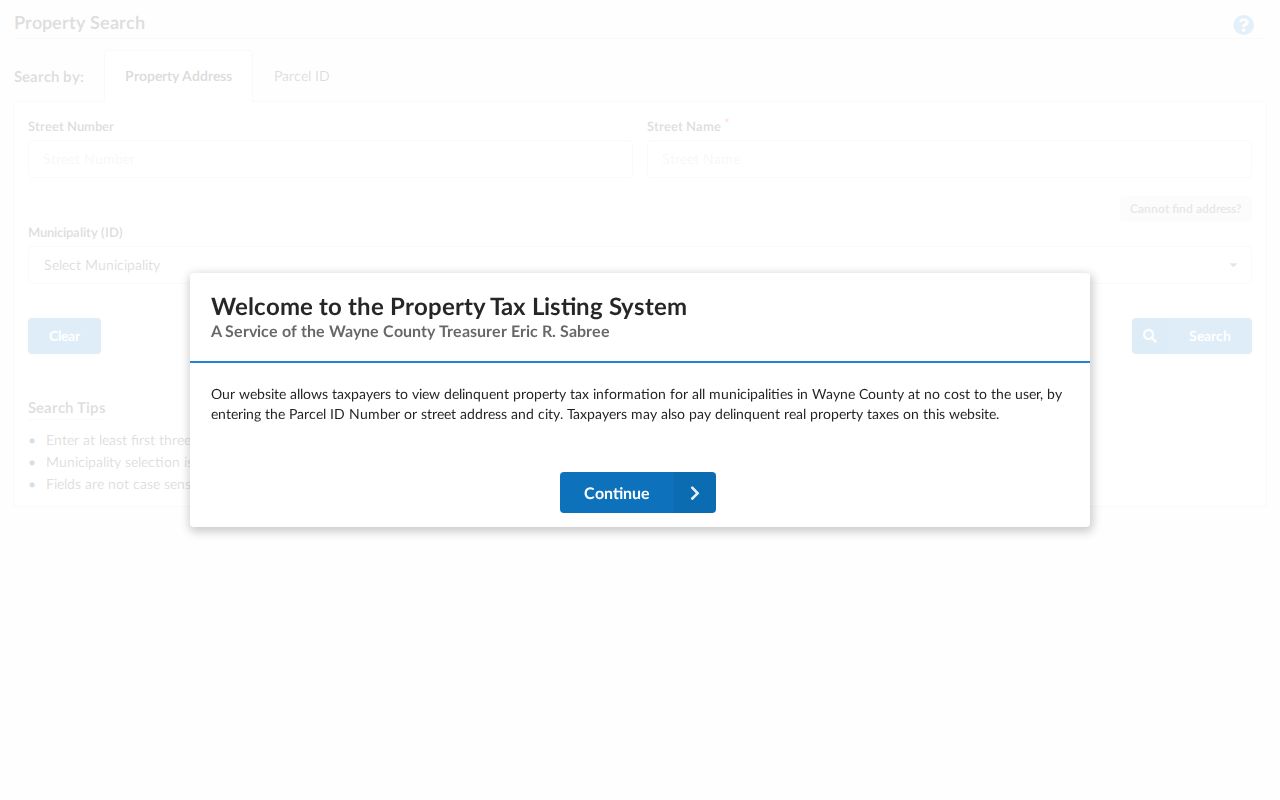
Use a returned parcel as a lead, then confirm its legal description and recorded instrument before describing an ownership connection.
Map Wayne County Parcels First
The county map route is especially helpful where postal, tax, and municipal identities diverge. Wayne County Maps & Data links to parcel and map resources, and the county ParcelViewer REST service supports map layers, zoom, pan, selection, and sometimes analysis. A map click yields a candidate parcel, not a certified title record. Current detail remains a municipal responsibility, so a Detroit address may need the Detroit viewer and another city may require its own assessor or GIS portal.
A parcel is the stable geographic key used to connect map context with a deed chain. Retain the address returned by the map, parcel ID, legal description where available, and query date. Those details make it possible to distinguish an old common address from the legal address used in a recorded document.
Wayne County Maps & Data is the official entry point for the county GIS resources.
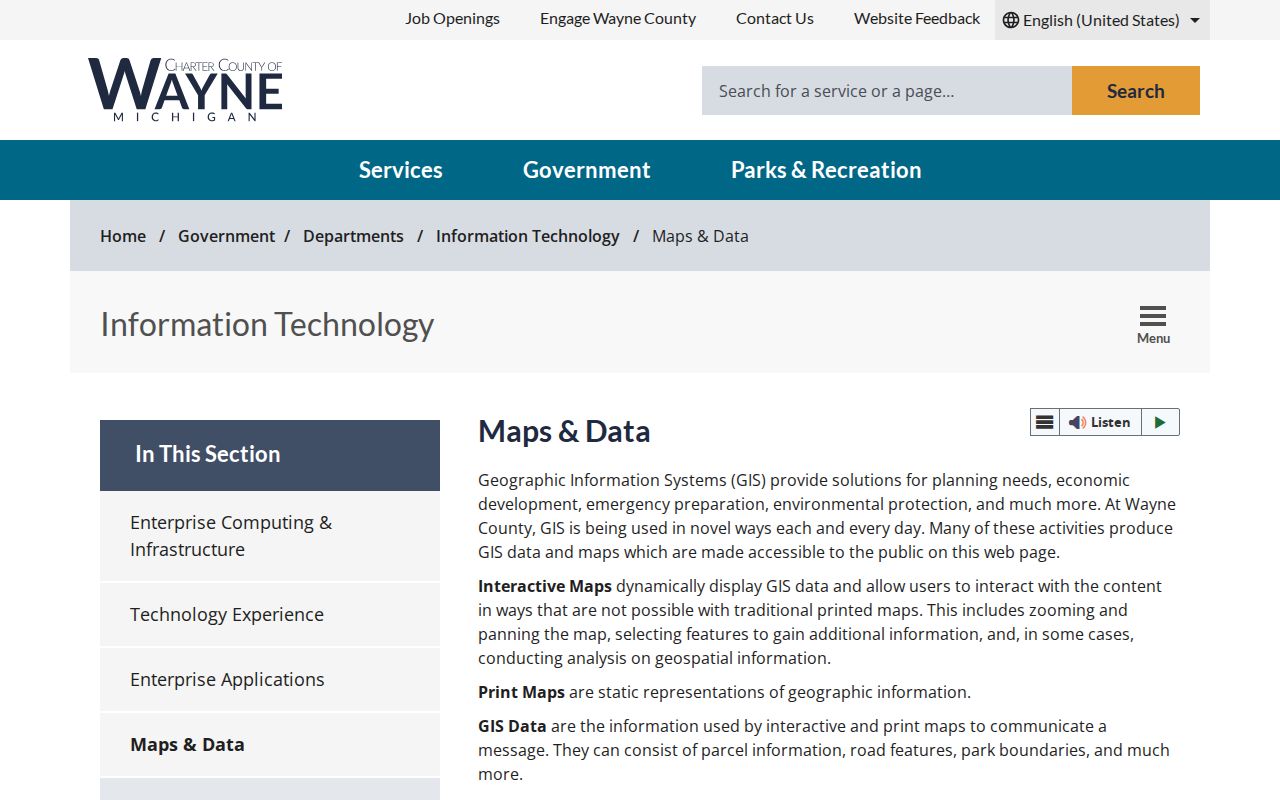
The parcel map establishes boundaries and map context, while the Register of Deeds supplies the recorded-document trail.
Current Wayne County Resident Directories
No single current Wayne County residents directory lists every household. Each source answers a narrower question. Parcel and tax systems identify property-related parties; the land index identifies parties to recorded instruments; MVIC checks individual registration and precinct information; and a QVF request is a formal, defined public-record process. Court, custody, license, and vital sources are event or status records rather than proof that a person lives at a particular address today.
| Record route | Relationship shown | Custodian | Access limit |
|---|---|---|---|
| Local assessment or parcel record | Owner, taxpayer, or property field | Municipal assessor | Confirm current local coverage and date. |
| Delinquent tax search | Tax and parcel context | Wayne Treasurer | Not a resident or certified-title record. |
| Recorded land index | Grantor, grantee, or instrument party | Register of Deeds | Online copies begin in 1960; older material may need office or archive routing. |
| MVIC or QVF request | Registration status or lawful public file fields | Michigan Department of State | Protected fields are redacted and a QVF request has defined scope. |
| Historical city directory | Person listed at an address in a year | Library or archive | Coverage varies by place, format, and year. |
When the goal becomes one person rather than an address, the Wayne County resident lookup route helps keep identity, event type, and custodian separate.
Wayne County Owner Labels Matter
An owner, taxpayer, mailing address, and resident are not interchangeable. Detroit’s official 3741 Cortland parcel sample shows a taxpayer LLC and a Staten Island taxpayer address for a Detroit parcel. That example is a useful comparison because the record does exactly what a tax record should do: it identifies a property-related taxpayer field. It does not identify a current household. The same caution applies to a deed grantee, a post-office ZIP, a directory subscriber, and a court party.
| Parcel | A geographic unit used for assessment, maps, and legal descriptions. |
|---|---|
| Roll | A dated government list, such as an assessment or registration record, with a defined purpose. |
| Index | A finding tool that points to a record; it may not include the full certified document. |
| Criss-cross directory | A historical directory arranged by street and house number instead of only by surname. |
Note: Preserve the source label exactly, then seek independent confirmation before connecting a person to an address.
Detroit Address Case Records
Detroit adds municipal records that can help explain a property-related event without becoming resident evidence. The Detroit Assessor directs users to BS&A Online for municipal assessment information, although the research did not capture a completed live field-by-field transaction. Detroit’s Department of Appeals and Hearings search accepts a ticket number or a violator name or business combined with violation street number and street. Returned cases can include violation address, dates, code, inspector, disposition, and payment history.
Detroit DAH Online shows the ticket and address search surface for municipal blight cases.
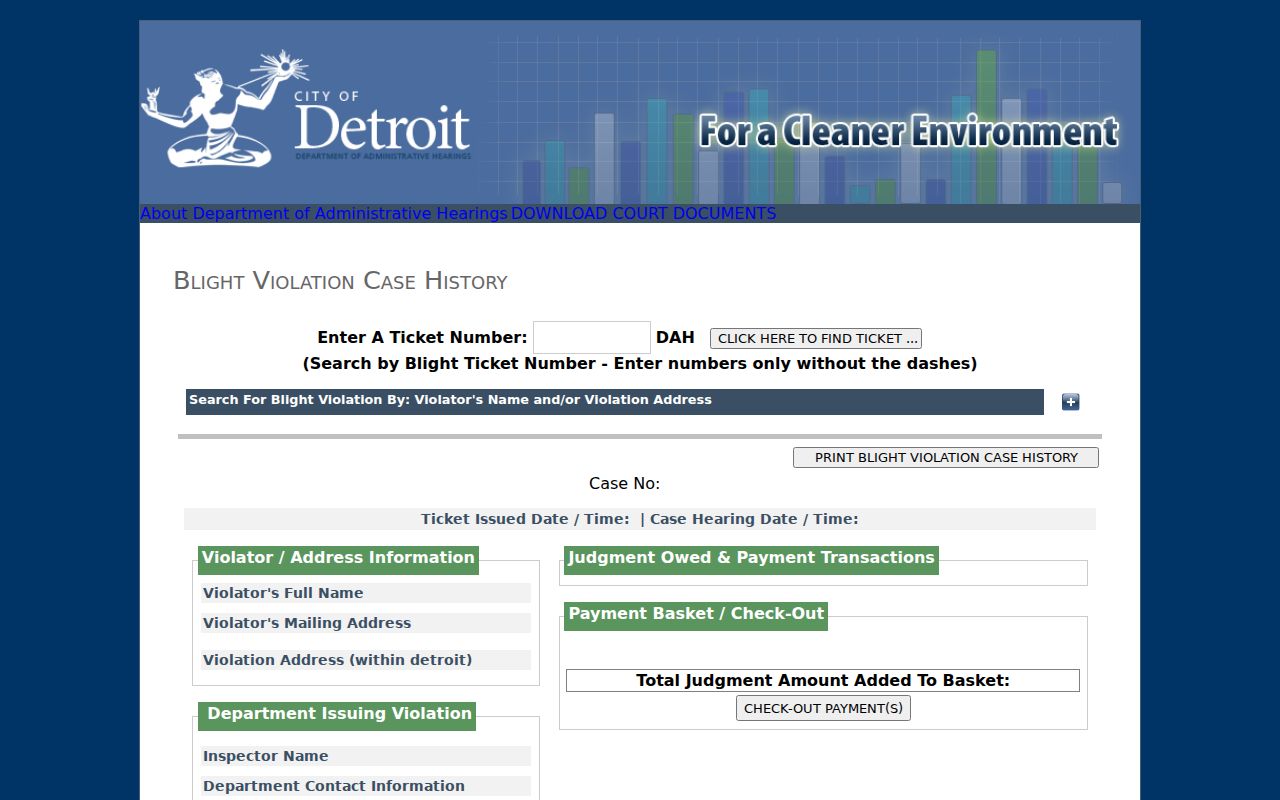
A violator mailing address or a ticket is a case field, not proof of ownership, residence, or wrongdoing.
Wayne County Municipal Assessment Route
Assessment data has two layers in Wayne County. County Assessment & Equalization makes annual files, building information, legal descriptions, historic maps, and boundary material available after the March Board of Review. It is retrospective and periodically updated. The current assessment question belongs with the local city or township assessor. For Detroit, the Assessor public counter is at the Coleman A. Young Municipal Center and links to the municipal online assessment route.
BS&A Online is the municipal property-assessment route linked by the Detroit Assessor.
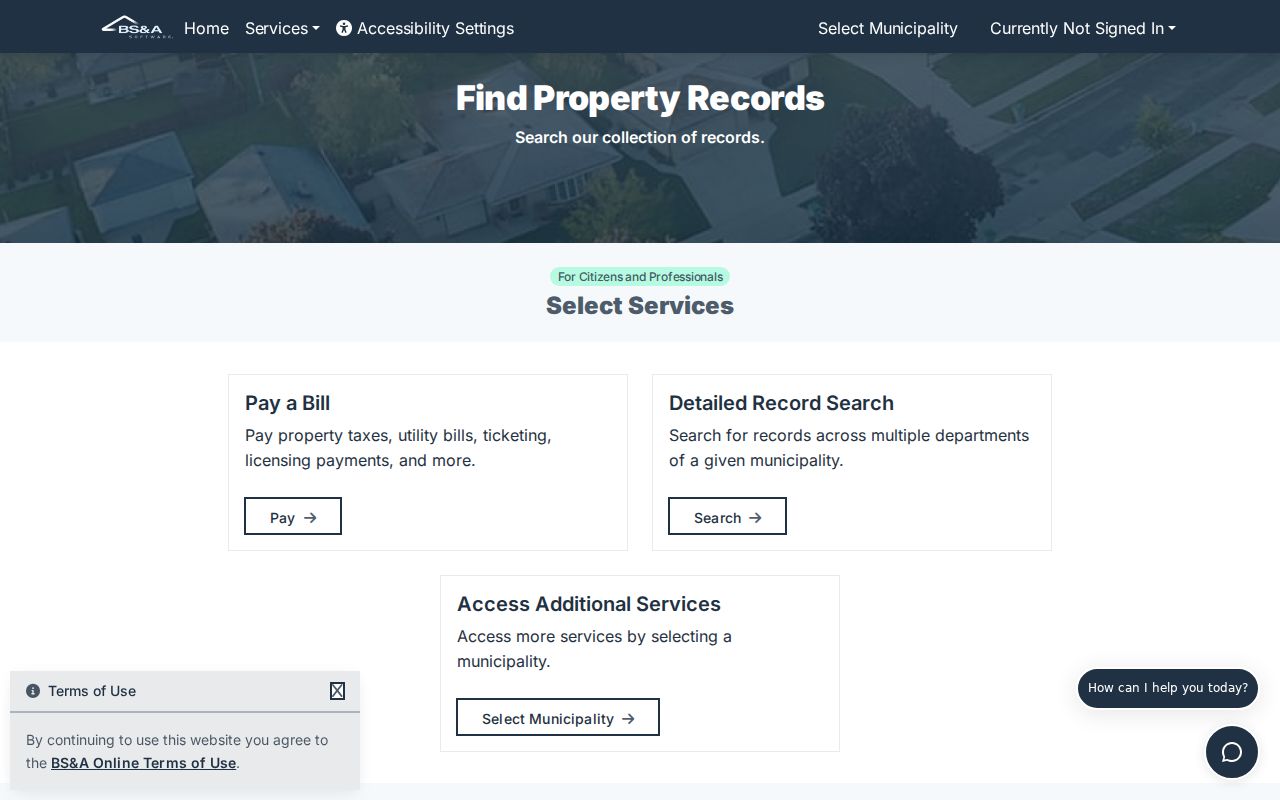
Use the municipal assessment result with its update context, then compare it with a parcel map and recorded deed rather than relying on one field.
Michigan Vote and Wayne County QVF
Michigan Vote/MVIC is the individual status, clerk, and precinct route. It is not a public bulk residents directory. A defined geographic Qualified Voter File request uses the state form and must select a scope such as a county, city or township, district, or ward or precinct. It can request permitted public fields and selected history, with delivery by pickup, encrypted flash drive, FTP, or mail rather than ordinary email.
Michigan law protects declined-registration data, receiving office, driver or state ID number, month and day of birth, phone, email, digitized signature, ACP information, and other protected records. Registration status changes, so retain the access date. A voter-history item establishes participation in a named election when it is lawfully included; it does not establish a person’s full-year physical presence at an address.
Note: Use a precise geography and date range when requesting an existing record from a public custodian.
Wayne County Court Index Limits
The Third Judicial Circuit Court of Michigan Odyssey public access system can search criminal cases by case, defendant, citation, attorney, or filing date and non-criminal cases by case, party, attorney, or filing date. Search controls include status and date bounds, and party searches can use exact-name or soundex-style options. Results show a case number, style, filing location, type, and status. The portal states that its public access is unofficial and that party-filed documents are not online.
Use a court result as an index lead and request the relevant document from the correct custodian when confirmation matters. Wayne County Clerk civil and divorce records run from 1942 forward under the described routing, but Detroit criminal material and later records can route to Frank Murphy Hall of Justice. Older files may require Archives ordering. Court roles also matter: a plaintiff, attorney, guardian, witness, and defendant are not equivalent labels.
Wayne County Clerk Records Division explains the county records routes used when a public search cannot supply the document itself.
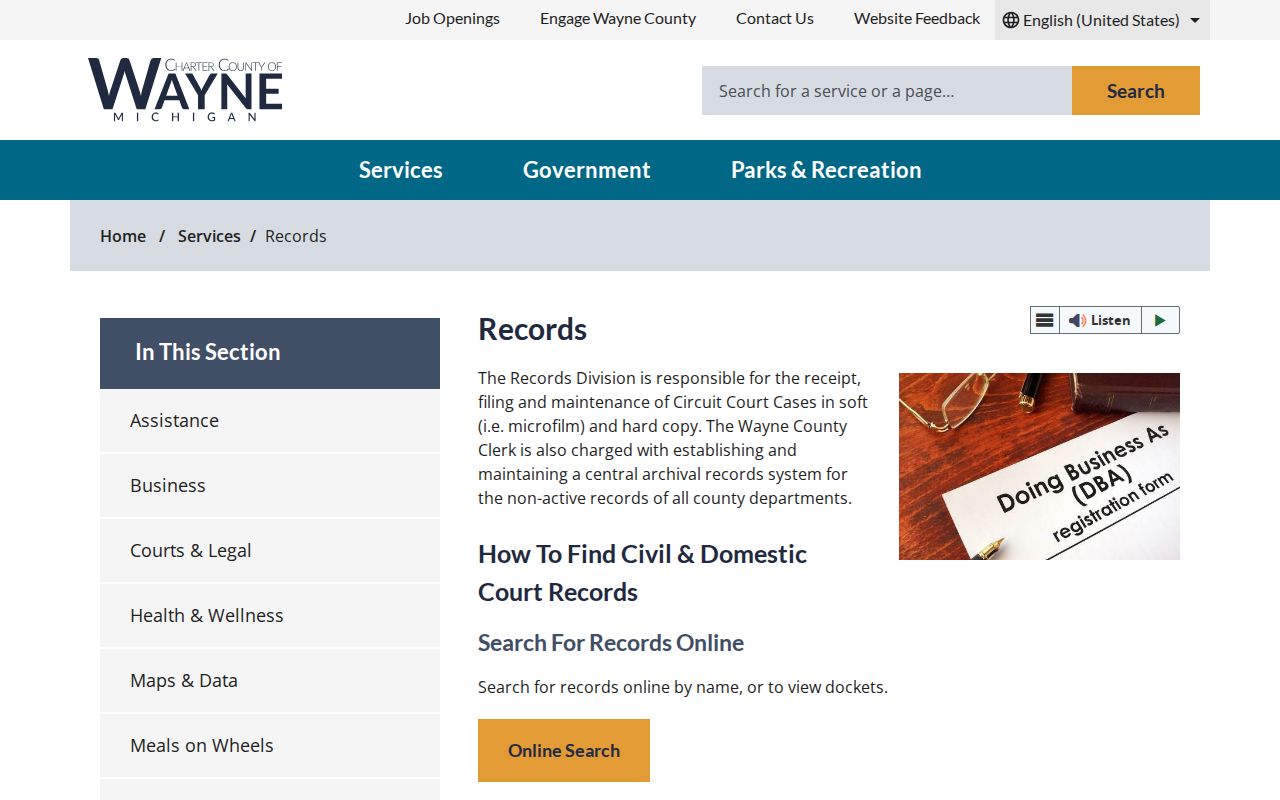
The Clerk route supplies request, records-room, mail, and archival alternatives to a portal-only search.
Wayne County Vital Event Records
Michigan Vital Records is the statewide ordering point for Wayne County birth, death, marriage, and divorce certificates and verifications. These are event and relationship records, not a current residents directory. Birth copies are restricted before 100 years to eligible people and categories identified by the state; older birth records are unrestricted. Death, marriage, and divorce records follow their own order rules. A divorce judgment comes from the court that finalized the case, not from the statewide certificate route.
The state offers mail, online VitalChek, phone, drop-box, and appointment channels. Its standard search fee is listed as $34 plus a $14 online processing charge, and searches are non-refundable even if no record is found. A verification provides limited event information rather than a full certificate. Use the state’s current order page for the controlling eligibility, fee, and processing details.
Wayne County FOIA Record Requests
The Michigan Freedom of Information Act is Act 442 of 1976, MCL 15.231 et seq. Under MCL 15.235, a public body generally responds within five business days and may take one extension of up to ten business days. A request should identify the custodian, existing record, date range, address or parcel identifier where relevant, desired format, and contact information. It cannot require an office to create a new analysis or certify an assembled claim about a current resident.
Wayne County’s general FOIA request entry provides the county’s request route and coordinator information.
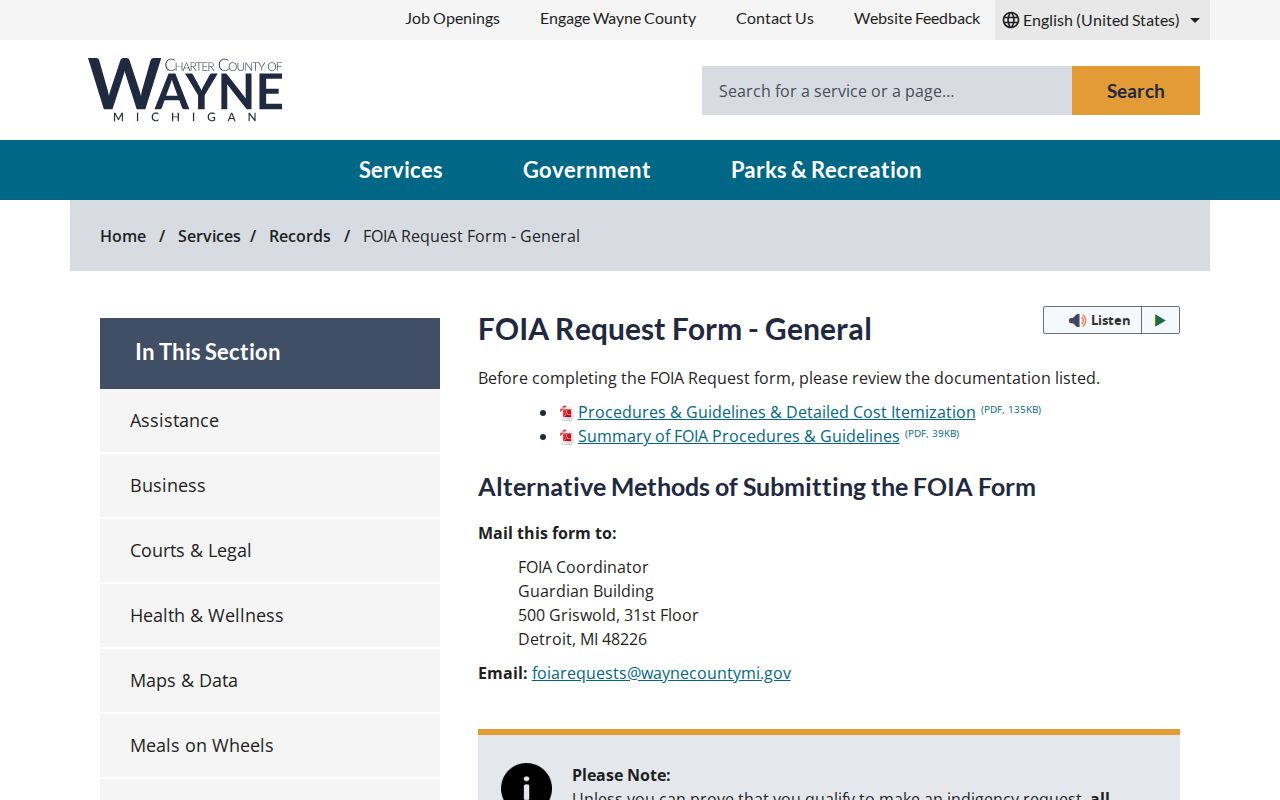
A focused request for a known record is more useful than a request asking an agency to invent a countywide resident list.
Wayne County Protected Address Limits
Public access has real limits. Michigan’s Address Confidentiality Program protects designated addresses and related records for qualified participants. Protected QVF information, exact day and month of birth, driver and state ID numbers, signatures, and private contact details must not be reconstructed through cross-record joins. A missing address result can reflect a date gap, an unindexed source, a municipality split, a protected record, or a query that did not match the portal’s format. It is not proof that someone does not live in the county.
The state Attorney General’s Address Confidentiality Program is the correct route for a protected-address concern. When an index appears to disclose protected information, stop and consult the custodian rather than republishing the detail.
Historical Wayne County Resident Directories
Historical Wayne County residents directory research is strongest in Detroit at the Detroit Public Library’s Burton Historical Collection, while suburban coverage varies and must be checked by city and year. DPL lists Detroit directories for 1837, 1845 to 1846, 1850 to 1941, and selected East and West volumes through 1974. Those gaps matter. Burton also holds telephone directories, maps, newspapers, obituaries, church records, cemetery material, land records, and family-history resources. Many sources are on-site or staff-mediated.
Polk, telephone, and Bresser or criss-cross formats answer different questions. A street-oriented entry can show house number, head of household, telephone, ownership notation, and relocation clues, while a surname entry may lead with occupation and address. A directory places a person at an address in a particular year. It does not prove the full household or current residence. The Wayne County city directories collection route gives the year runs and format distinctions in greater depth.
Wayne County Negative Search Results
A careful Wayne County residents directory search records a negative result as a coverage fact. Note the custodian, exact input, date, portal, search mode, and the portal’s stated limits. The online land index begins with recorded-document copies from January 1, 1960 even though older county records exist. Detroit and township coverage differ. A historical street can have a changed spelling or numbering scheme, and a postal city can differ from the legal municipality. These details explain why a seemingly obvious search can fail.
For older address research, compare the printed address, parcel or legal description, historic map or plat, directory year, and later record rather than silently converting everything to a modern address. Wayne County was established in 1796 and Detroit was founded in 1701, so changing custodians, languages, and municipal boundaries are part of the research record. The 1893 Wayne County and Detroit atlas is a useful period source for plats, subdivisions, and landowner context.